
 +994 50 503 67 66
Blog
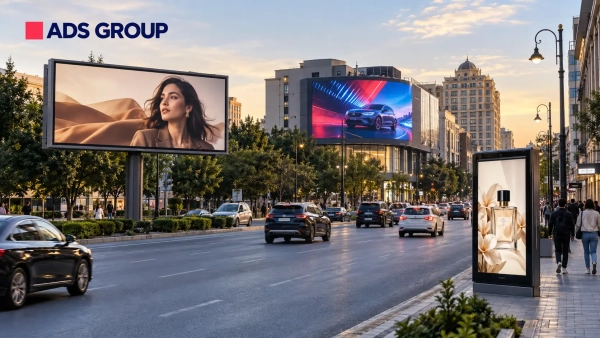
Billboard, LED Screen, or Scroller: Which Is More Cost-Effective?
When planning an outdoor advertising campaign, one of the main questions businesses face is which advertising format is the most suitable. Billboards have long been used to reach broad audiences, LED screens display moving and changing content, and scrollers make it possible to show several posters in rotation on a single advertising structure.
Each format can generate high visibility. However, their pricing structures, content capabilities, typical locations, and campaign purposes differ. Therefore, there is no single answer to the question “Which is more cost-effective?” that applies to every business.
A cost-effective choice does not simply mean selecting the cheapest type of advertising. The key is to reach the right audience within the available budget, present the advertising message in the right format, and create visibility that supports the campaign objective. When conducting a billboard, LED screen, and scroller comparison, businesses should consider campaign duration, location, how often the message will change, and design requirements in addition to price.
Key Differences Between Billboards, LED Screens, and Scrollers
| Criterion | Billboard | LED screen | Scroller |
|---|---|---|---|
| Content format | Fixed printed poster | Video, animation, and static visuals | Printed posters displayed in rotation |
| Changing content | Requires new printing and installation | Can be updated quickly in digital form | Requires new posters to be printed and replaced |
| Main advantage | Continuous, uninterrupted visibility | Dynamic imagery and content flexibility | Several messages on one structure |
| Suitable campaign | Brand awareness and long-term messaging | Short-term, changing, and highly visual campaigns | Campaigns involving several products or messages |
| Night visibility | Depends on lighting | Bright digital display | Usually an illuminated surface |
| Initial production | Design, printing, and installation | Video or screen-formatted content | Several designs, printing, and installation |
| Audience exposure | The advertisement remains continuously visible | The advertisement appears according to a display schedule | Each poster is visible for a set interval |
This table provides a general comparison. The actual choice should be based on the structure’s location, viewing direction, campaign duration, and display conditions.
What Is Billboard Advertising?
A billboard is a large-format advertising surface generally installed on streets and avenues with heavy vehicle and pedestrian traffic, at road junctions, city entrances, and along highways. The advertising poster remains unchanged on the surface for a specified period.
The main strength of a billboard is the stable and continuous visibility of its message. If the advertising space is not shared with other brands, the audience encounters the same message every time they pass the structure. This helps people remember the brand name, product, and campaign message.
Advantages of Billboard Advertising
The advertising message remains continuously visible on the same surface;
Its large size attracts attention from a distance;
It is suitable for long-term brand campaigns;
It can be used in urban and highway locations;
It is effective for a simple and powerful visual message;
It creates repeated exposure along the same route;
It can direct people to a branch, store, or development.
Limitations of Billboard Advertising
Changing the content requires reprinting and installation;
It is difficult to present many messages on one poster;
A weak design may remain in place for a long time;
A non-illuminated surface may not be sufficiently visible at night;
Printing and installation costs arise at the beginning of the campaign.
Which Campaigns Are Billboards Suitable For?
Billboards may be suitable for brand awareness, new product launches, real estate developments, automotive campaigns, store openings, corporate image campaigns, and long-term service promotion. If the message will remain unchanged throughout the campaign and continuous visibility is important, a billboard is generally the more appropriate choice.
You can learn more about billboard features and the factors affecting price in the article “Advantages and Prices of Billboard Advertising”.
What Is LED Screen Advertising?
An LED screen is an electronic outdoor advertising structure used to display digital video, animation, and static visuals. Unlike a printed poster, its content can be updated through a management system. This makes it possible to display different messages, products, and offers during the same campaign.
The moving and bright imagery of an LED display helps attract visual attention. However, the advertisement usually appears in rotation with other advertising content. Therefore, the screen’s location is not the only consideration: the video duration, number of daily displays, and broadcasting hours are also important.
Advantages of LED Screen Advertising
Video, animation, and changing visuals can be used;
Content can be updated without printing or physical installation;
Different products and offers can be displayed in rotation;
Dates, prices, and campaign information can be updated quickly;
It provides bright visibility during both the day and night;
It is flexible for short-term sales and event campaigns;
The same content can be adapted for different screens.
Limitations of LED Screen Advertising
The screen may be shared with content from other brands;
Visibility depends on display frequency and rotation order;
A poorly produced video may not be understood within a short display time;
Very fast animation and lengthy text may distract the viewer;
Content must match the screen’s technical dimensions and format;
Brightness and technical condition affect the actual viewing quality.
Which Campaigns Are LED Screens Suitable For?
LED screens are suitable for frequently changing prices, multiple products, limited-time discounts, events, automotive presentations, entertainment, retail, and dynamic brand campaigns. When content needs to be updated and several messages must be shown during the campaign, an LED screen provides a more flexible solution.
Read more in the article “Why Does LED Screen Advertising Attract More Attention?”.
What Is Scroller Advertising?
A scroller is an illuminated advertising structure in which several printed posters are displayed in rotation using a special mechanism. Unlike a fixed billboard, it shows different advertising visuals on one surface. Unlike an LED screen, its content consists of physical printed posters rather than a digital display.
The movement created when posters change can attract attention. Scrollers are particularly suitable for urban locations shared by vehicle and pedestrian audiences. Their effectiveness depends on the location, the display duration of each poster, lighting, and design readability.
Advantages of Scroller Advertising
Several visuals can be displayed on one advertising structure;
Poster transitions add a sense of movement to static advertising;
One brand can promote several products in rotation;
Illumination supports visibility during the day and at night;
It is an attention-grabbing format for urban campaigns;
A campaign message can be presented in stages;
Different creative visuals can be shown in the same location.
Limitations of Scroller Advertising
Each poster is visible only at set intervals rather than continuously;
Separate design and printing may be required for several posters;
The technical condition of the mechanism and lighting is important;
Text may not be fully readable while the poster is changing;
Every design must be clear and understandable on its own.
Which Campaigns Are Scrollers Suitable For?
Scrollers are suitable for presenting several product lines, delivering campaign messages in sequence, promoting different services from the same brand, and creating a moving visual effect in an urban setting. For businesses that want to use several creative visuals while preserving print quality, a scroller can be a balanced alternative between a billboard and an LED screen.
Learn more in the article “What Is Scroller Advertising and Where Is It Used?”.
Which Format Is More Cost-Effective?
There is no universal price comparison for billboards, LED screens, and scrollers. The final cost varies according to the location, size, campaign duration, characteristics of the advertising surface, content production, printing, installation, and display conditions.
Billboard Pricing Structure
The main expenses in a billboard campaign may include rental of the advertising space, design, poster printing, installation, and removal. As long as the content remains unchanged, there is no need for additional video production. In a long-term campaign with a stable message, spreading the initial printing and installation cost over a longer period can make the billboard cost-effective.
LED Screen Pricing Structure
LED advertising does not require physical printing. The price may be based on the screen’s location and size, the duration of the advertising video, display frequency, broadcasting hours, and campaign duration. If no ready-made video is available, a separate budget may be required for animation and content production.
Scroller Pricing Structure
In addition to renting the structure, scroller advertising may involve the preparation, printing, and installation of one or more posters. If the goal is to show several products in the same location, using one scroller may be more suitable in some campaigns than renting several separate billboards.
Therefore:
A billboard may be cost-effective for one fixed message and long-term visibility;
An LED screen may be suitable for frequently changing content and updates without printing;
A scroller may be an efficient choice for showing several printed visuals in one location.
Prices should be compared based on the same location, period, and scope of services. Looking only at the final amount does not provide an accurate conclusion.
Visibility Comparison
Billboard: Continuous Visibility
The main advantage of a billboard is that the advertising surface is dedicated to the same brand throughout the campaign. The audience sees the same message every time they pass the structure, which supports brand recall.
LED Screen: Bright and Dynamic Visibility
An LED screen can attract attention through motion and light. However, because the advertisement appears during a specific interval, the audience must be looking at the screen at that moment. Display frequency and the first seconds of the video are especially important.
Scroller: Attention Through Mechanical Movement
A scroller creates visual movement as the posters change. To see the complete advertisement, the audience needs to be in front of the structure during the poster’s display interval. The format may be easier to absorb at junctions and in areas where traffic slows down.
Which Format Offers the Most Content Flexibility?
If the content will change frequently, an LED screen is the most flexible format. A new product, different price, campaign date, or current announcement can be updated digitally.
If several predesigned visuals need to be shown in rotation at the same point, a scroller may be suitable. A physical poster is required for each change, but different messages can be displayed within the same campaign.
If a campaign has one main message that must remain unchanged for a long time, a billboard is a simpler and more focused choice.
Choosing by Campaign Duration
Long-Term Campaign
A billboard may be suitable for brand awareness, corporate image, a new residential development, or ongoing service promotion. Repeated exposure to a fixed visual helps the message remain memorable.
Short-Term Campaign
An LED screen is flexible for discounts, events, openings, new products, and date-specific offers. Content can be updated quickly when the campaign ends or its conditions change.
Multi-Stage Campaign
A scroller may be used when several products, services, or sequential messages are presented. Each poster should carry a separate message while together forming one consistent campaign.
Design Differences
Billboard Design
A billboard design should be understandable from a distance and within a short viewing time. One main headline, a strong visual, a clear logo, and a simple call to action are more effective. Long text and numerous contact details make the message harder to read.
LED Screen Content
The main message should appear within the first seconds of an LED advertising video. The content should remain understandable without sound, transitions should be simple, and text should be large. The video should not become an overly long story because the audience may see the screen for only a short time.
Scroller Design
Each scroller poster should work as a standalone billboard. The message on one poster must be understandable without the others. Considering the poster transition, the main text should be placed in the central safe area.
Which Format Should Be Selected for Each Location?
The effectiveness of an advertising format cannot be assessed separately from its location.
High-Speed Highways and City Entrances
In these areas, a large billboard with a short message that is visible from a distance may be more suitable. Videos and rotating posters may not be fully absorbed when the audience has very little viewing time.
Road Junctions and Areas Where Traffic Slows
These locations may be favorable for LED screens and scrollers. The audience has more time to watch the advertisement change or view a short video.
Central and Brightly Lit Urban Environments
LED screens and illuminated scrollers may attract attention at night. However, if the area contains many bright screens, the advertisement requires the right design to stand out from the visual competition.
Areas Near a Point of Sale
A billboard provides a simple way to show a specific direction and distance. If a store runs frequently changing campaigns, a nearby LED screen may offer greater flexibility for current promotions.
Available structures can be reviewed by city, street, advertising type, and size in the ADS GROUP advertising locations section.
Which Advertising Type Is Suitable for Each Business Sector?
Real Estate and Construction
If the project name, main benefit, and contact details will not change for a long time, a billboard is a suitable choice. An LED screen can be used to present different apartment types, campaign stages, and price updates.
Automotive Companies
A billboard may suit a new model or a corporate brand campaign; an LED screen may suit a moving vehicle presentation and several models; and a scroller may present different models on separate posters.
Retail
A billboard can be selected for long-term store promotion, an LED screen for daily and weekly offers, and a scroller for presenting different product categories at the same location.
Banking and Insurance
A billboard can build corporate trust and brand awareness, a scroller can present various loan and card products, and an LED screen can display changing campaign terms and digital visuals.
Events and Entertainment
If dates, programs, and visual materials change frequently, an LED screen is more flexible. A scroller may also be suitable for presenting several participants or parts of the same event program.
Restaurants and Service Businesses
A billboard can provide directions to the venue, an LED screen can display changing menus and campaigns, and a scroller can promote several services and offers.
Which Format Is Best Suited to Each Objective?
| Campaign objective | More suitable starting option | Reason |
|---|---|---|
| Long-term brand awareness | Billboard | Stable and continuous visibility |
| Frequently changing discounts and prices | LED screen | Content can be updated quickly |
| Presentation of several products | Scroller or LED | Different visuals can be shown |
| Video and animation display | LED screen | Digital moving content |
| Directing people to a store | Billboard | The message remains continuously visible |
| Several printed messages in one location | Scroller | Posters can rotate |
| Bright visibility at night | LED screen | The display has its own light source |
| Short, powerful highway message | Billboard | Visible from a distance and continuously displayed |
These choices provide general guidance. A final decision should be made after reviewing the specific location and campaign conditions.
Can All Three Advertising Types Be Used Together?
Billboards, LED screens, and scrollers may compete with one another, but they can also support different stages of the same campaign. For example:
A billboard displays the campaign’s main message over a long period;
An LED screen presents the product using moving imagery;
A scroller shows different products and benefits in rotation.
In an integrated campaign, every visual should use the same color system, headline, logo, and call to action. Even when the format changes, the audience should recognize that it is seeing the same brand campaign.
When using several advertising types, the main goal should not simply be to increase the number of surfaces but to create a consistent audience journey.
Common Mistakes When Choosing an Advertising Format
Focusing Only on the Lowest Price
An inexpensive format in an unsuitable location or with weak display conditions may not deliver the expected results.
Choosing an LED Screen Only Because It Moves
If the video is poorly produced or the display frequency is unsuitable, the screen technology alone will not make the campaign effective.
Placing Too Much Information on a Billboard
A billboard remains visible for a long period, but the audience may see it for only a few seconds during each pass. Too much text makes the message difficult to read.
Designing Scroller Posters That Depend on One Another
The audience may not see all the posters in sequence. Therefore, each visual should communicate an independent message.
Selecting the Format Without Reviewing the Location
On a high-speed road, an LED video or rotating scroller message may not be fully visible. The format must match the actual viewing time.
Ignoring Campaign Duration
A long-term fixed poster may not suit an event lasting only a few days, while frequently changing and unfocused content may not suit long-term brand awareness.
Practical Checklist for Making the Right Choice
Before requesting a quote, answer the following questions:
What is the campaign’s primary objective?
Will the advertising message change during the campaign?
Will one product or several products be shown?
Are video and animation genuinely necessary?
How many days or months will the campaign last?
In which areas does the target audience travel?
Should the advertisement be visible mainly during the day or at night?
How long will the audience be able to see the advertisement?
Is there a separate budget for printing, installation, or video production?
Is uninterrupted visibility important?
Is one location sufficient, or is citywide coverage required?
Is the information likely to be updated during the campaign?
These questions make it much easier to choose between the formats.
How Does ADS GROUP Select the Right Advertising Format?
In professional advertising planning, the campaign objective and audience are determined before the advertising structure is selected. Suitable locations, formats, and service packages are then compared.
An advertising campaign with ADS GROUP can be planned through the following stages:
Defining the objective and target audience;
Selecting suitable locations in Baku and the regions;
Comparing billboard, LED screen, and scroller options;
Creating a design suited to the advertising size and viewing time;
Preparing print, video, or animation materials;
Organizing installation and advertising placement;
Providing a campaign photo report and technical support.
You can compare the general characteristics of the formats on the advertising types page.
Frequently Asked Questions
Which Is Cheaper: a Billboard, LED Screen, or Scroller?
There is no universal answer for every location and campaign. The price depends on the advertising location, size, duration, printing and content production, installation, and display conditions.
Which Format Is More Suitable for Long-Term Advertising?
If the message will not change and uninterrupted visibility is required, a billboard may be suitable. If the content will be updated regularly, an LED screen is the more flexible choice.
Is Video Required for LED Screen Advertising?
No. A static visual can also be displayed on an LED screen. However, the content should be designed for the screen’s size, brightness, and display duration.
How Many Advertisements Are Shown on a Scroller?
The number of posters and display sequence depend on the technical specifications of the individual structure. When requesting a quote, clarify the number of posters and the visibility interval for each advertisement.
Is Billboard Advertising Visible at Night?
Night visibility depends on the billboard’s illumination and the surrounding lighting conditions. When choosing an advertising location, it is useful to review a nighttime photograph of the structure and verify the lighting.
Can All Three Formats Be Used in One Campaign?
Yes. A billboard can deliver the main message, an LED screen can display dynamic content, and a scroller can present several products and benefits. A consistent visual identity should be maintained across all formats.
Which Format Attracts the Most Attention?
LED screens and scrollers may attract attention through movement, while billboards benefit from the message being continuously visible. Actual performance depends on the location, design, viewing time, and relevance to the audience.
What Information Is Needed for an Accurate Quote?
You should provide the campaign objective, target audience, city or district, desired duration, approximate budget, number of content pieces, and design requirements.
Conclusion
When choosing between a billboard, LED screen, and scroller, considering only price and technology is not enough. A billboard provides stable and continuous visibility, an LED screen offers dynamic and quickly updated content, and a scroller presents several rotating printed messages in one location.
If you want to display one main message for a long period, a billboard may be the better option. If campaign terms and visuals will change frequently, an LED screen provides an advantage. If you want to present several products or services in the same advertising location while preserving print quality, a scroller may be the right choice.
The most cost-effective advertising format is not necessarily the one with the lowest price; it is the format that best matches your business objective, audience, location, and campaign duration. To make the right choice, all three options should be compared based on the same service package and real display conditions.
To compare billboard, LED screen, and scroller options for your business, select suitable advertising locations, and receive a tailored quote, contact ADS GROUP. Together, we can plan an outdoor advertising campaign that fits your objective and budget.